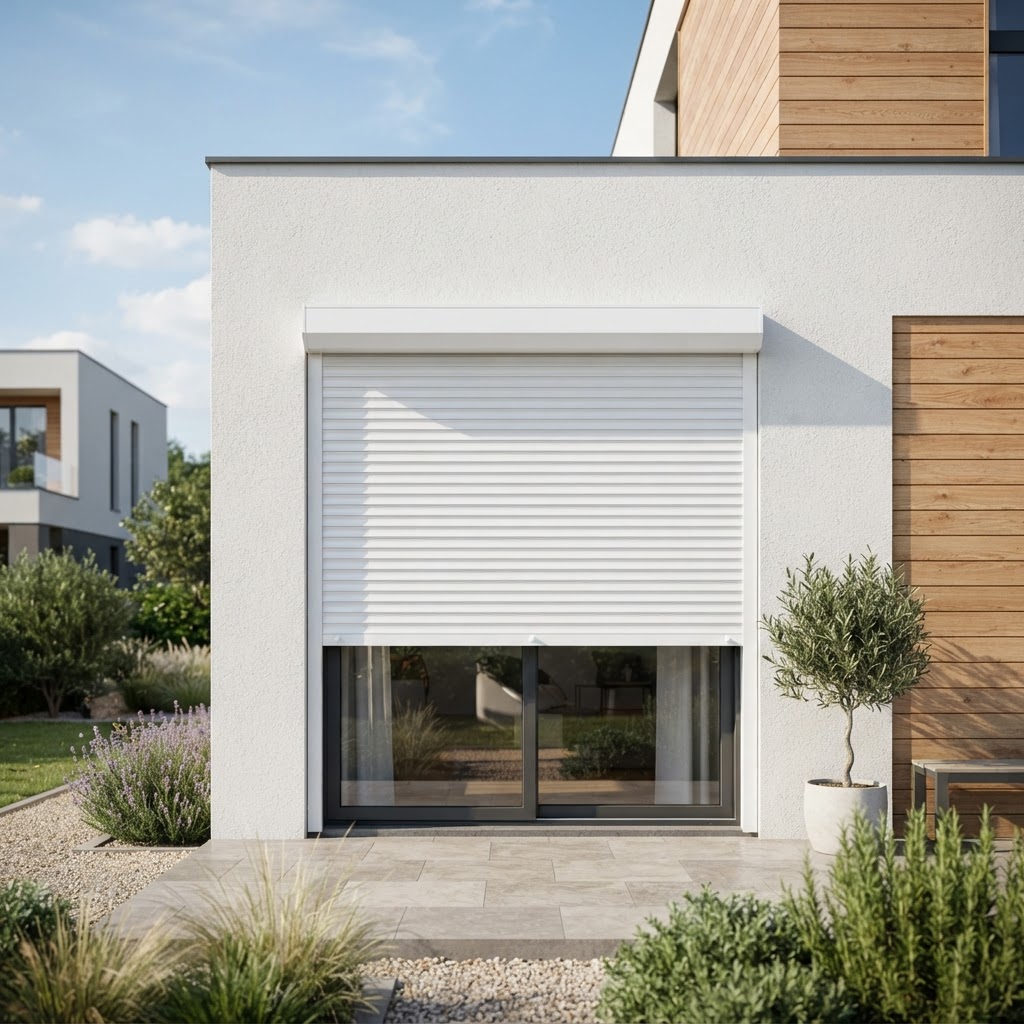
Conventional or security motorised roller shutters?
It is eight o’clock in your Marbella flat. With one touch, the shutters rise together, daylight comes in and the house wakes up without you walking from window to window. In the evening, another touch closes the sitting room while you check that the terrace is secure. The convenience of a motorised roller shutter is easy to understand; the important point is not to mistake it automatically for physical security.
The two categories we are comparing are the conventional motorised roller shutter and the motorised security roller shutter. Both roll their slats into a box, and both can provide shade, privacy and simple control. The real difference lies in how the complete assembly has been designed, made, fixed and, where applicable, tested.
The comparison at a glance
| Point | Conventional motorised | Motorised security |
|---|---|---|
| Priority | Everyday comfort, shade and privacy | Making access harder at an exposed opening, depending on the model |
| Components | Slats, guides, box and motor sized for the opening | Construction, locking and fixings with more emphasis on resistance |
| Best fit | Upper floors and openings with less accessible exposure | Ground-floor homes, chalets, holiday homes and reachable balconies |
| What to check | Noise, insulation, control and maintenance | Exact tested assembly, guides, fixing, locking and safe escape |
Motorised convenience is not a security certification
A motor removes the strap, crank and effort of moving a wide shutter. It can group schedules, stop the slats at a chosen height and close several windows before you leave. Used thoughtfully, it makes a home easier to manage: an empty property can look cared for, and a second home can be closed up more easily.
But a motor on its own does not turn conventional slats into a tested security barrier. Resistance depends on the slat profile, the lock, the side guides, the box, the fixing into the building and the way the parts work together. With a motorised security roller shutter, ask for information about that complete assembly, not just the word “motorised”.
When a conventional shutter makes sense
On an upper floor with windows that are not easy to reach, a conventional motorised roller shutter can be the sensible choice. It manages strong Mediterranean sun, improves privacy and makes closing the home at dusk effortless. It also suits spaces where daily convenience matters most and physical exposure from outside is low. Slats and finishes vary; the box, guides and motor still need to match the opening, its weight and the intended use.
Its limits are just as important. A shutter designed for shade and comfort should not be presented as an intrusion barrier. Also check any balcony that could be reached from a roof, patio, external staircase or neighbouring structure: being above ground level does not make an opening inaccessible.
When to consider a security shutter
A motorised security roller shutter deserves closer study on ground-floor properties, chalets, holiday homes and large doors or windows opening onto a garden, patio or street. In a holiday home, accessible openings need particular attention because the property may be unoccupied for long periods. Apply the same assessment to first-floor balconies if they can be reached without much difficulty.
Depending on the model, the system may use extruded aluminium slats, a locking arrangement, or profiles and guides designed to offer greater resistance. These are not universal features, so ask for the specification of the model being installed. As a general technical reference, Persax’s public information about security roller shutters describes an intermediate blocking profile on particular models. It is an example of a possible solution, not a specification for every security shutter and not a claim about the brand of the product supplied.
Installation matters as much as the slat
Before choosing a colour, inspect the opening. The size and position of the box can affect the lintel, usable space and interior or exterior appearance. Guides need enough depth and a sound fixing surface; fixings must work into solid structure rather than only a fragile finish. On a renovation, check joints, junctions and possible moisture paths as well.
A heavier slat needs a motor and barrel capable of moving it smoothly. Width, height, cycle frequency, access to the box and the electrical supply all affect the choice. With a security solution, the extra weight and stronger guides may require a more careful check of the structure and available space. Good installation prevents the motor being overloaded, the curtain running out of alignment or the fixing becoming the weak point.
Power cuts and escape routes
Ask whether the model has a manual override or alternative operation when the power fails; systems differ. If a shutter protects a door or escape route, the arrangement must let people get out without improvising. A closed shutter must not become a trap during a power cut, fire or other emergency. The installer should explain the operation and leave it accessible to everyone in the household.
Do not force the curtain or take the box apart to free a jam. The spring, barrel, slats and motor may carry stored tension or weight. If you hear an unusual noise, see a tilted shutter or experience repeated failure, stop using it and arrange a professional inspection.
Distinct advantages and trade-offs
Conventional motorised
- Advantages: easy daily operation, good control of light and privacy, and a discreet solution for openings with lower accessible exposure.
- Trade-offs: it does not, by definition, provide the resistance of a security assembly; it still relies on correct installation and maintenance.
Motorised security
- Advantages: it can make access to a vulnerable opening more difficult and shows that resistance has been considered in the design.
- Trade-offs: it is often heavier and more demanding of the guides, fixings, box and motor; when closed, it may reduce daylight and needs an escape-route check.
No roller shutter is “burglar-proof”. If a certification or resistance class is mentioned, check that it belongs to the exact combination of slat, guides, box, lock and fixings being installed, not to one component or a different configuration. Request the evidence and the maker’s instructions before treating a performance claim as established.
Coastal conditions and a practical decision
In Marbella, salt air, humidity and fine dust are part of life for any external fitting. Follow the maker’s maintenance instructions for the chosen model: cleaning, frequency, compatible products and motor checks can differ. Do not reach for solvents or abrasives, and do not open the box to “improve” it without professional guidance.
Choose conventional motorised roller shutters when your priority is automated comfort at openings with less accessible exposure. Consider motorised security roller shutters when the opening is genuinely reachable and you want a solution designed and, where applicable, tested as an assembly. A mixed approach is perfectly sensible: security shutters on patio doors and ground-floor windows, conventional shutters upstairs. At Los Especialistas, we can assess each opening and recommend an installation that fits your priorities. Explore our roller shutter service or contact us to discuss your project.
General technical reference on security roller shutters. It is cited for general concepts; it does not indicate that the product supplied will be a particular brand or that every model shares its solutions.